Visuals
The Main Street vision
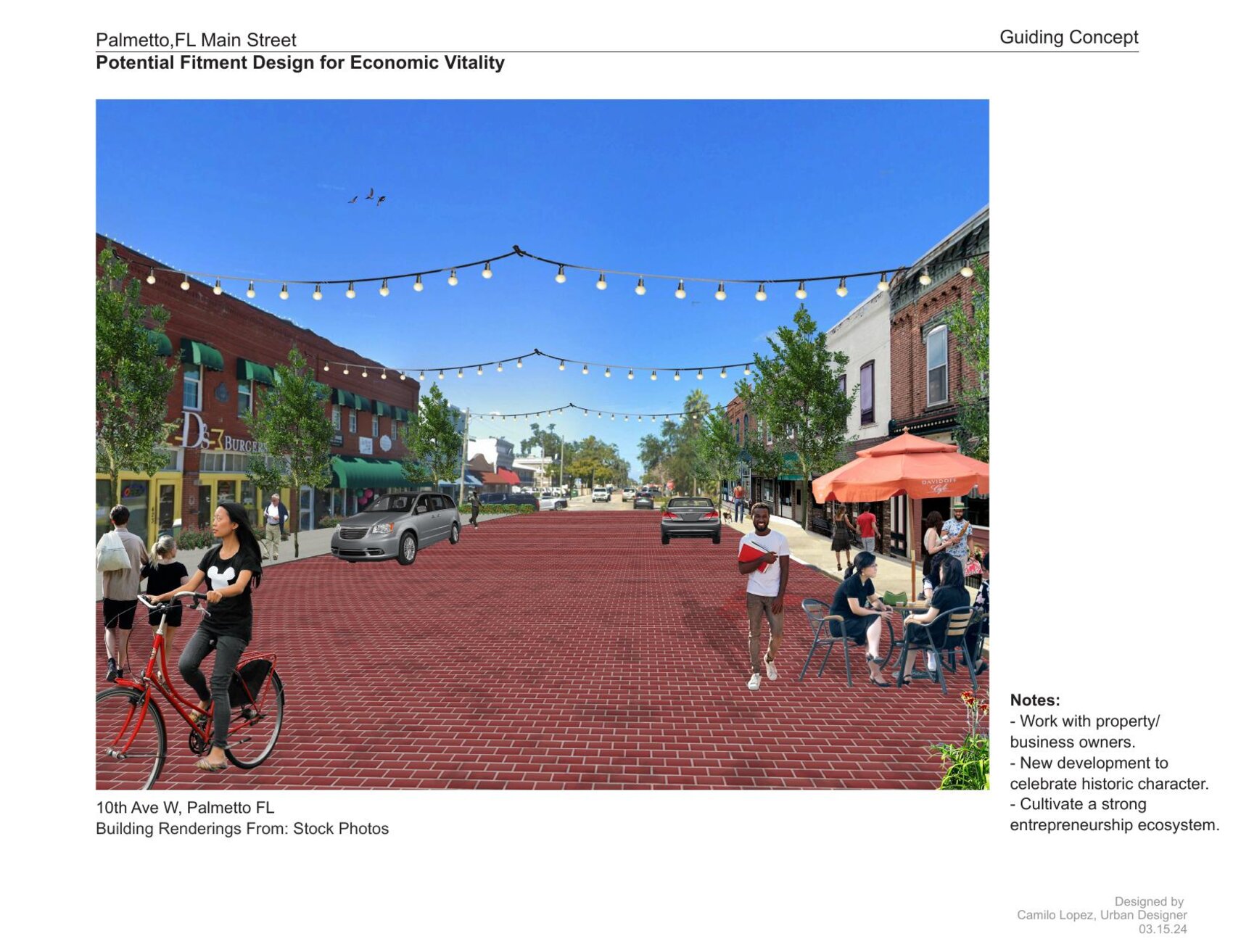
A data-driven economic assessment, placemaking vision, and phased streetscape plan to turn Palmetto's historic 10th Avenue Main Street into a place people want to be and stay.
The Florida Department of State, Division of Historical Resources engaged BusinessFlare® to deliver a comprehensive economic analysis for Palmetto Main Street — the historic 10th Avenue W corridor linking Sutton Park, the museum district, and the city's busy riverfront marina. The work paired a rigorous data and market analysis with a placemaking vision and a phased streetscape design.
BusinessFlare® analyzed the district's economic drivers — land, labor, capital, markets, and regulation — alongside foot-traffic patterns, the business mix, void analysis, and quality-of-life connections. The finding was clear: Palmetto has a large, captive market and real historic character, but lacks the space, streetscape, and awareness to convert that traffic into a thriving Main Street.
Palmetto captures roughly 1.4 million downtown visits and 353,700 marina visits a year, yet Main Street sees only a fraction of that flow — held back by little available and appropriate space, rents too low to justify new development, a car-scaled streetscape, and low awareness of what is already there. With the City and CRA controlling key opportunity sites, the opportunity is to leverage that public land and captive market into new space, food-focused entrepreneurship, and a walkable street on par with its park and waterfront anchors.
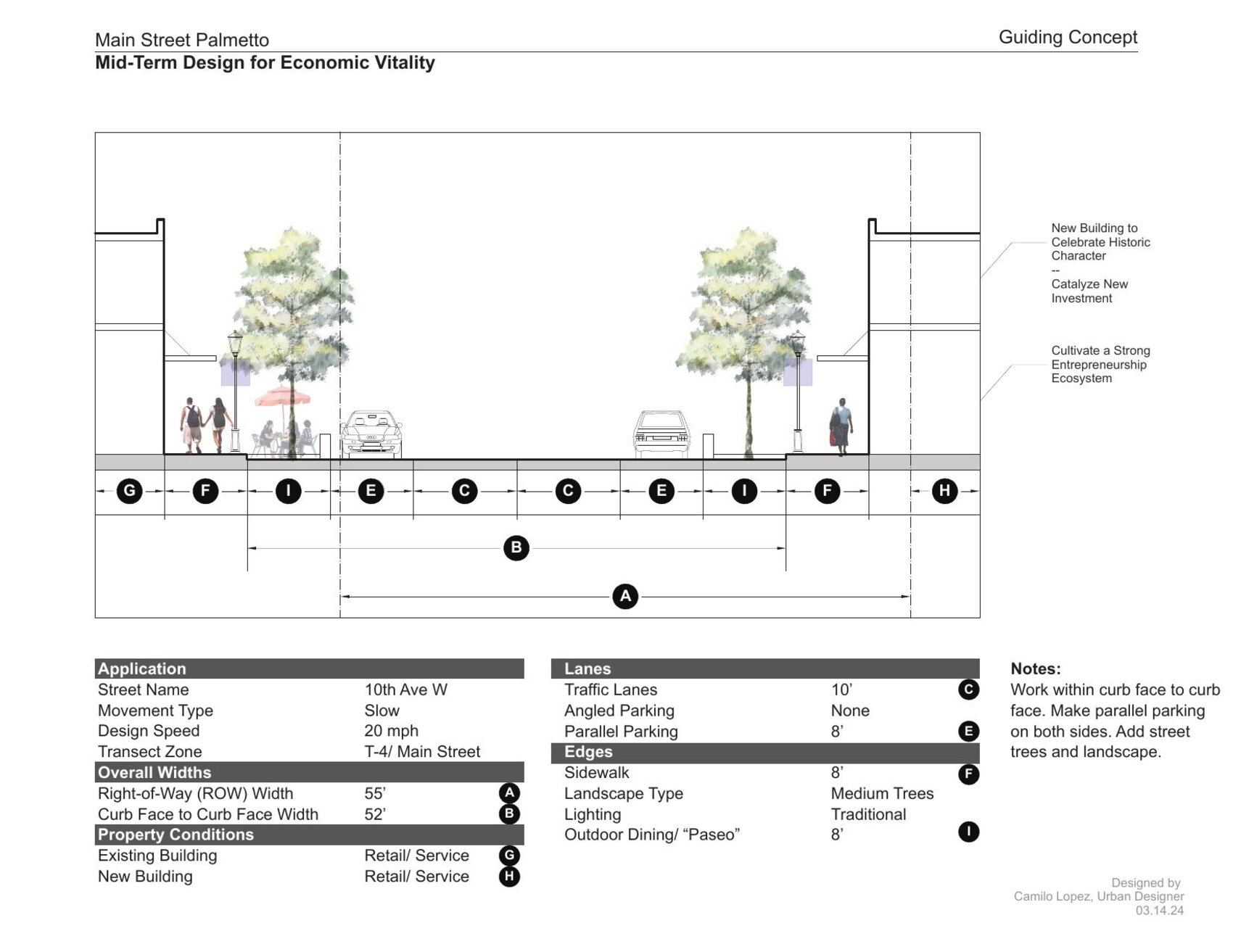
From economic diagnosis to a phased vision and street-section designs for 10th Avenue W.
BusinessFlare® diagnosed the district through five economic drivers, combining ESRI Business Analyst demographics, CoStar real-estate data, and Placer.ai foot-traffic analytics to establish where customers come from, what they want, and why development had stalled.
Using Placer.ai and favorite-place data, the team mapped where Main Street and marina customers come from and where they dine before and after visiting, then ran a void analysis to identify business types that fit the market but are missing.
BusinessFlare® framed the vision around PIECE — preserving the Main Street's character and pace, investing in what's already there, enhancing east-west connections and the public realm, capitalizing on the captive market and public land, and exposing the connection between Main Street and the water.
Detailed street sections for 10th Avenue W (a 55-ft right-of-way, 52-ft curb-to-curb, T-4 Main Street transect at a 20 mph design speed) show a phased path from today's car-dominated section to a walkable, dining-friendly street.
The assessment closed with a Main Street Approach organized around the four points — organization, economic vitality, design, and promotion — pairing partnerships and funding with targeted, outcome-focused actions.